SODOTO — What It Is, How It Works, Where It Runs
Marc Pierson and Claude Opus 5.5 · September 2026, updated October 2026
A federated apprenticeship credentialing system. A skill is witnessed, practiced, and taught — then cryptographically certified by a Neighborhood Development Center (NDC) and published to a portfolio anyone can verify in a browser, with no server call and no login.
What SODOTO Is
SODOTO (See One, Do One, Teach One) issues verifiable digital credentials for practitioner skills. The credential documents not just that you have a skill, but how you acquired it: who showed you, who witnessed your practice, and who you subsequently taught. The chain of transmission is embedded in the credential and cryptographically signed by the issuing NDC organization.
The name comes from a medical training tradition: you observe a procedure done by an expert, you perform it yourself under supervision, and you teach it to the next learner. Each step is a gate. All three must pass before a full credential is issued.
Two properties make it different from an ordinary certificate:
- Credentials are issued by cooperatives, not individuals. The signing authority is the NDC — persistent and institutional — not dependent on any one person. A mentor's departure never invalidates what they witnessed.
- Verification needs no server. Anyone viewing a portfolio page can click Verify. The browser recovers the issuer's public key directly from its DID (Decentralized Identifier) string and checks the signature. No registration, no login, no third party — permanently, for as long as the credential and its DID exist.
SODOTO is skill-agnostic. Each NDC defines its own list of skills to credential — systems-mapping tools, health-partner practices, trades, facilitation methods, anything a cooperative wants to transmit rigorously. The three-gate machinery is the same regardless of the skill. Anything that requires training can use SODOTO.
The Three-Gate Workflow
Every credential passes through three sequential gates. Gates cannot be skipped. A gate may take several attempts — the record of each attempt, including ended ones, is preserved as evidence of rigor.
See One
The mentor demonstrates the skill in a real working context. The learner observes closely. Both record a brief assertion — the mentor that they showed it, the learner that they understood — and the session is documented on a FedWiki narrative page.
Do One
The learner performs the skill themselves while the mentor witnesses. Both assert. If the mentor is not satisfied, the attempt is recorded as ended and another Do One is scheduled. There is no penalty for multiple attempts.
Teach One
The learner teaches a new student while the mentor witnesses the teaching. Both the mentor and the student attest. The student's own Do One page is the evidence record — you cannot claim Teach One without a real student who actually did the skill.
What each gate records
| Gate | mentorAssertion | learnerAssertion | outcome |
|---|---|---|---|
| See One (pass) | showed | understood | complete |
| Do One (pass) | satisfied | has-done | complete |
| Do One (ended) | not-satisfied | has-done | ended |
| Teach One (pass) | satisfied | has-taught | complete |
Each gate also records the mentor's name and DID, a date, and a link to a narrative page. Teach One additionally records the student's name, DID, portfolio slug, and the slug of the student's Do One evidence page.
Roles
| Role | Who | What they do |
|---|---|---|
| Learner | Anyone seeking a credential | Goes through all three gates in sequence. May need multiple Do One or Teach One attempts — all are preserved. |
| Mentor | Someone who holds a complete, sealed badge in the skill — earned, or a founding badge | Accepts a learner's request or offers to mentor, records each gate from their own portfolio (recording is their signature), and countersigns the learner's invitation to their student. Their DID is embedded in the credential. |
| Student | The person the learner teaches at Teach One, invited by the learner | Does a Do One session under the learner's teaching and signs Teach One. Once the learner's badge is sealed, that Teach One counts as the student's own See One in the skill. |
| Inviter | Any badge holder, an NDC's key holder, or a learner past Do One (for their own student, with the mentor's countersignature) | Signs an invitation; the newcomer opens the link, makes their own key and is registered and given a site with no one in the middle. |
| NDC key holder | Whoever holds an issuing NDC's private key | Starts the chain by declaring founding badges, and seals finished contracts from the Issuer's Seal tab. Everything between those two steps is signed by the people it is about. The key holder can still do any step by hand for someone who cannot do it themselves. |
| Issuing NDC | The cooperative (RCN, a health NDC, The Fledge, …) | Its Ed25519 key pair signs the credential; its DID is the issuer. Trust is tied to the institution, not any individual. |
Where Every Piece Runs
Where every piece runs. Dashed arrows are out-of-band (image build/push, shared-volume writes); solid arrows are live HTTPS traffic.
The three containers (on the WikiCafe server)
| Container | Image | Serves |
|---|---|---|
| sofi-proxy | ghcr.io/marpie1/rcn-sodoto-proxy |
The issuer tool (sodoto-issuer.html) and all FedWiki write calls. Runs the demo seed at startup when SEED_DEMO is set. Reachable at sodoto.ndcgroup.relocalizecreativity.net. |
| FedWiki | ghcr.io/marpie1/rcn-sodoto-wiki |
Learner portfolio pages and the badge ledger, rendered by the vendored sodoto-badge plugin (pinned to wiki@0.27.0). Reachable at wiki-sodoto.ndcgroup.relocalizecreativity.net. |
| Caddy | caddy:latest |
HTTPS reverse proxy; obtains and renews TLS certificates automatically via Let's Encrypt. Routes each subdomain to the container above. |
The two SODOTO containers share a wiki-data volume, so pages written by sofi-proxy are served immediately by FedWiki. A second sodoto-data volume holds the people registry. Configuration lives in the server's .env (domains, the write passphrase, an optional Anthropic key) — never in the images or in git. Full compose/Caddy config is in deploy/docker/.
How each person connects
| Person | URL | What happens in their browser |
|---|---|---|
| NDC key holder | sodoto.ndcgroup.relocalizecreativity.net/tools/sodoto-issuer.html | Declares founding badges and seals finished contracts; pastes the NDC key seed to sign. HTTPS makes Web Crypto signing available. |
| Newcomer (joining) | …/tools/sodoto-onboard.html#invite=…, the invitation link someone sent them | Sees who invited them, signature checked; mints their own Ed25519 key, chooses a passphrase, downloads a recovery file, and is registered and given a site in the same step. The private key never leaves the device. |
| Learners, mentors, students | their own portfolio, and the signing pages it links to (sodoto-invite, sodoto-contract, sodoto-record, sodoto-sign, sodoto-leave) | Notes at the top of the portfolio say what is waiting; each action opens a page that shows exactly what is being signed, signs it on the device, and sends it to the server, which checks it. |
| Anyone | …/tools/sodoto-people.html, the People page | Who is in SODOTO: name, NDC, badges (Founding or Earned), who invited them; sortable and filterable by NDC; Ask for a mentor under each badge holder’s badges. |
| Any person, on their own site | <their-slug>.wiki-sodoto.ndcgroup.relocalizecreativity.net | Signs a one-time challenge with their key to claim and edit their own portfolio and write their own account. No password. |
| Verifier (anyone) | any portfolio site | Clicks Verify. The signature check runs entirely client-side — no login, no server call. |
Issuing a Credential
Since October 2026 there is no coordinator in the middle. Every signature is its own permission: each step is a statement signed in the browser of the person it is about, and the server checks the signature and the rule for that step (who may invite, who may accept, who witnessed what). The NDC's key holder starts the chain and seals what is finished. Full per-tab help is in the Issuer Tool Guide; the step-by-step for each role is in the User Manual.
- The key holder declares founding badges (Issuer → Founding badges). A skill needs a first holder before anyone can earn it. Pick the skill and the person, write the grounds — why they can already teach it — and sign with the NDC key. The declaration is itself the badge: it goes straight onto their portfolio, marked Founding, and gives the same powers as an earned one.
- A badge holder invites a newcomer. Invite someone on their portfolio: type the name, pick the NDC, sign, and send the link any way they like. It works once, for 14 days. An NDC's key holder can also invite into that NDC.
- The newcomer joins. They open the link on their own phone or computer, check who invited them, read that their name will be public, choose a passphrase, and press Create my identity and list me. Their key is made on the device, they are registered, their own site is made, and they appear on the People page. Nothing is sent back to anyone.
- The contract opens between learner and mentor. The learner presses Ask for a mentor under a badge holder’s badges on the People page, or a badge holder offers to mentor someone; the other side accepts. Both signatures open the contract, under the NDC that sealed the mentor's badge. One open contract per learner per skill; an unanswered proposal lapses after 30 days.
- The mentor records each gate — See One, Do One, Teach One — from their own portfolio, and recording it is their signature. The learner, and at Teach One the student, then sign on their own devices from a note on their portfolio. After Do One, the learner invites their own Teach One student; the mentor countersigns that invitation.
- The key holder seals. Contracts with all seven signatures (mentor and learner at each gate, plus the student at Teach One) appear in the Issuer's Seal tab by themselves, already checked. Seal… opens one in Sign & Issue; paste the NDC's 64-character key seed and sign. The key is cleared right after and never sent anywhere.
- The badge is published automatically to the learner's portfolio and the ledger, marked Earned. The new holder can now mentor and invite, and the student's Teach One counts as their own See One — the chain grows by itself.
- Verify. Open the portfolio, click Verify on the new badge, and confirm ✓ Verified.
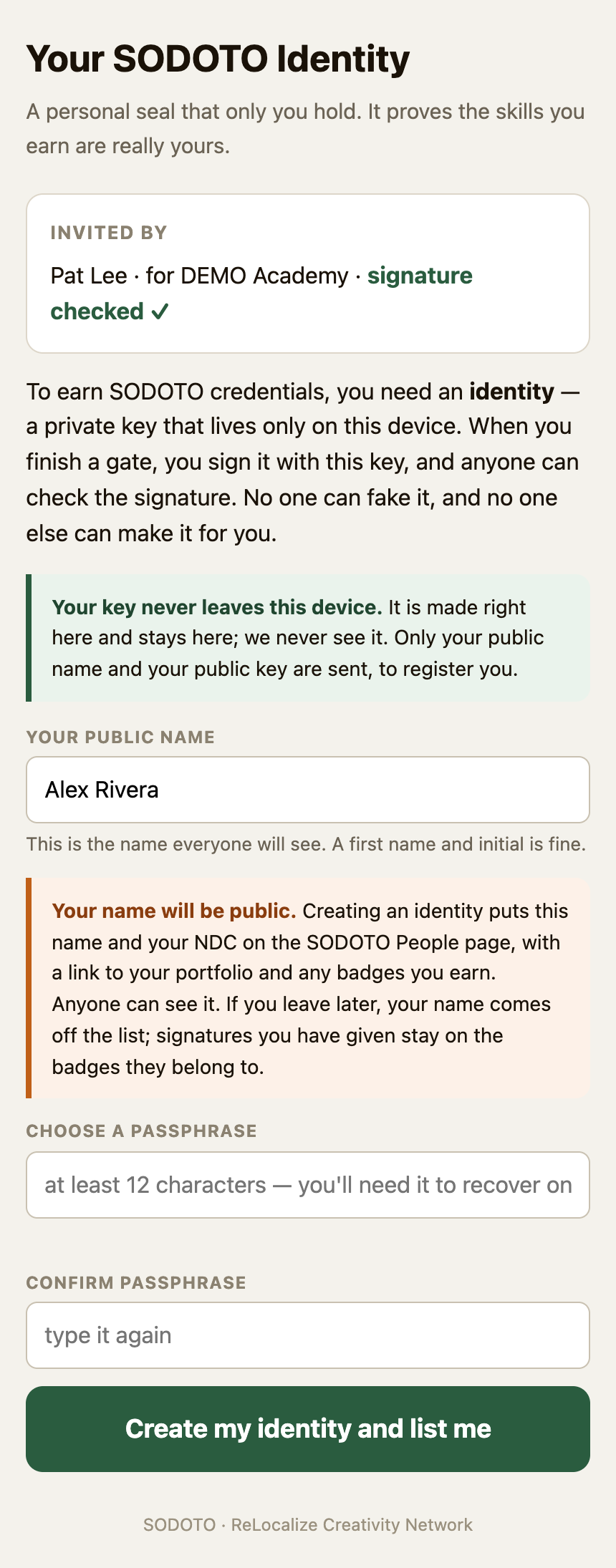
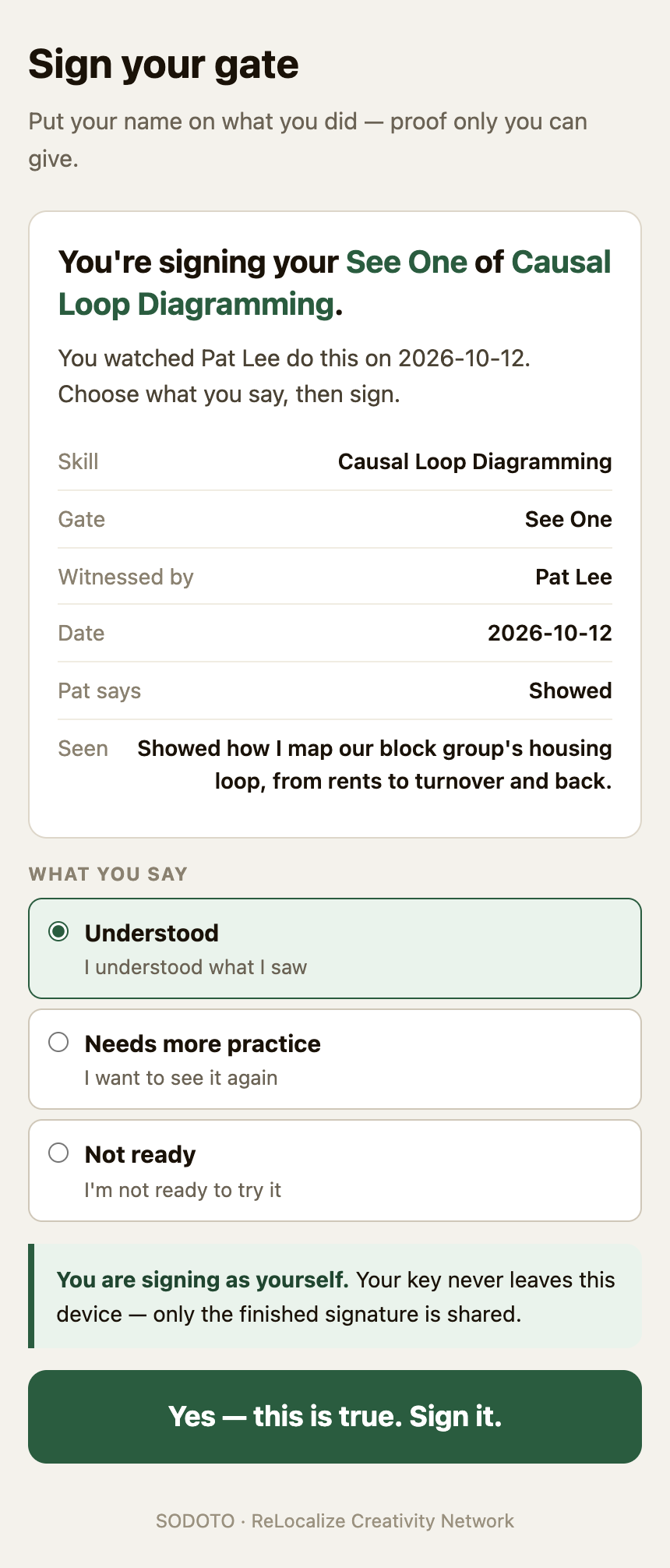
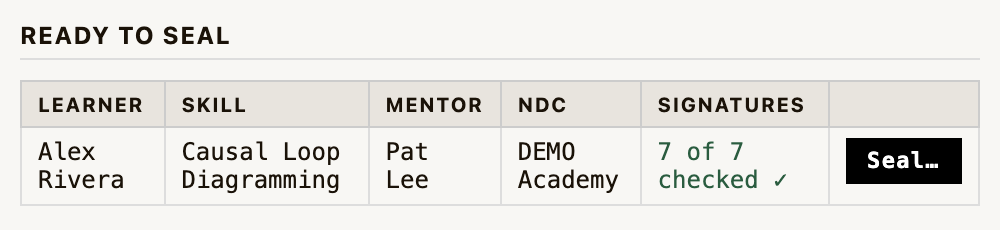
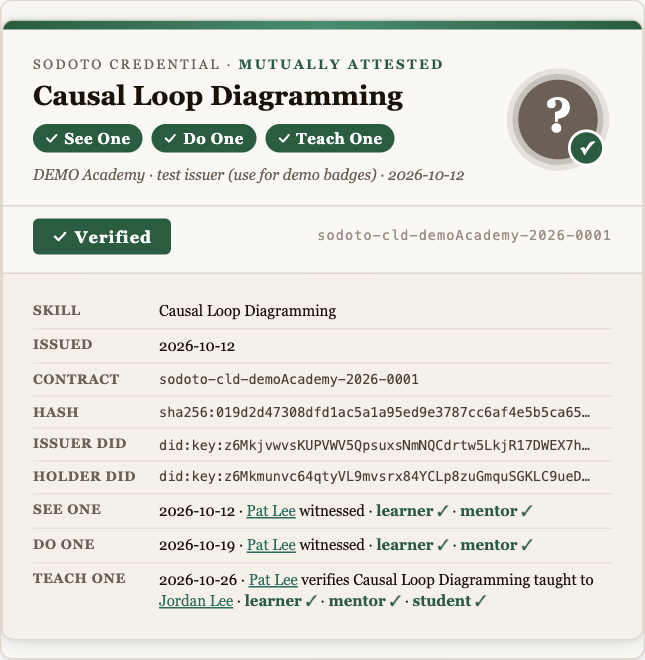
From a demo (DEMO Academy). The User Manual shows every step this way. Click a picture to see it full size.
How Verification Works
The did:key format encodes the issuer's public key directly in the DID string, so no lookup is ever required. When a user clicks Verify, the sodoto-badge plugin, entirely in the browser:
- Reads the
jwtfrom the badge markup and splits it into header, payload, signature. - Decodes the payload and reads
iss— the issuer'sdid:keystring. - Decodes the DID's multibase suffix back to the raw Ed25519 public-key bytes.
- Calls
crypto.subtle.verify()overheader.payloadwith the decoded signature. - Reports ✓ Verified or ✗ Failed.
The JWT is the credential. If the badge renders and Verify passes, it is authentic and unmodified — with no server, no expiry, and no third party.
Your Own Site
Each person gets a whole FedWiki site of their own — chris-casillas.wiki-sodoto.ndcgroup.relocalizecreativity.net — not a page on somebody else's wiki. Their portfolio lives there, and so does whatever they write about their own learning and mentoring: what they tried, what they used, what they would do differently. The credential is the record of the gates; the site is the account of the journey.
They own it, cryptographically. To edit, a person clicks Sign in with my SODOTO key and signs a one-time challenge with the private key on their own device. The server checks the signature against their DID. There is no password, and no key ever reaches the server. Ownership is not "first to sign in wins": the site is provisioned unclaimed, bound to the person's registered DID, and the badge is the authority — when the first badge lands, the holder's DID is stamped as owner. A portfolio with no badge and no expected holder cannot be claimed at all.
This is what makes the portfolio genuinely the person's. A mentor records the gate, but only the learner can sign their side of it, and no one else can edit their account after the fact.
The Portfolio Page
The portfolio page itself displays the badges, and at the top, notes for whatever is waiting for this person: a request to answer, a gate to sign, an invitation to countersign. Pages are written by sofi-proxy into the shared volume and served by FedWiki. Each badge, rendered by the sodoto-badge plugin, shows the skill and issuing NDC seal, whether it is Founding (declared by the NDC, with its grounds) or Earned (through the three gates), the three gate dates, mentor name(s) linked to their own sites, the full attempt history per gate, and a Verify button. Long badges collapse into an accordion, and the mentoring log groups attempts by learner and skill, most-recent first.
demo-alex-rivera) so the system can be shown end-to-end without exposing real people. Seeding is opt-in via SEED_DEMO, writes only files that are absent, and never overwrites real content. A production NDC simply leaves SEED_DEMO unset.Skills
SODOTO does not fix a skill list — each NDC credentials whatever it chooses. Two example families:
- Systems-mapping tools (RCN): Causal Loop Diagramming, e-VSM, EIP, Stock-and-Flow, OPM, the Vester Sensitivity Model, and others in the RCN toolset. The Vester cluster (nine interacting skills) will need a credential-cluster design before individual credentials are issued.
- Health-partner practices (a health NDC): skills such as Health Picture Review or care-plan note-writing — one cooperative's chosen skill set, credentialed with the same three gates. These belong to that NDC's program, not to SODOTO itself.
Whether a credential maps to a pay tier, a role, or nothing at all is a policy choice made by each cooperative — it is layered on top of SODOTO, not part of it.
Current Status
Live now
sodoto-badge plugin verifies any badge from its DID with no server call.sodoto/plugins/wiki-plugin-sodoto-badge/ is committed and baked into the wiki image — the repo is self-contained.Roadmap — decided Aug 2026
sodoto-onboard.html), issuer-generated onboarding links, per-gate signing (sodoto-sign.html), and required-for-full collection + verification in the issuer tool. The badge shows "learner-attested" and verifies each learner and student attestation client-side. Since October the learner and student sign from a note on their own portfolio and the signature goes straight to the server; the copy-and-paste return is only for the by-hand path.substrate/sodoto_projector.py reads badge truth from the portfolios and upserts (:Person), (:Organization), (:Skill), (:Credential), (:GateAttempt) and the teaching edges (TAUGHT / ATTESTED / HOLDS / ISSUED / CERTIFIES), idempotent on contractId. Neo4j is a queryable lens over the badges, never a dependency of issuing one; it runs on the Desktop Substrate. No debt node — that's the currency layer.Still open
docs/sodoto-ndc-auto-seal-spec.md, and its policy engine is written and tested, but it is not switched on.Set aside: Marlowe / on-chain gate execution — the signature chain (mentor + NDC + learner) already provides the enforcement, so a blockchain layer is not pursued. Value settlement, if ever wanted, belongs to the separate agreements/currency system (CfA-dSC), not SODOTO — and likewise the commons debt node, which is part of that currency layer, not the credential.
The Teaching Graph (designed)
SODOTO is designed to write its data into Neo4j so teaching chains and credential provenance are queryable — node types (Person, Skill, Credential, GateAttempt, Organization) and their relationships are specified; the writes are done by the Substrate-side projector above. This is provenance, and it stands on its own.
A separate, optional layer can attach an economics to teaching: when Teach One completes, real value has changed hands. If a cooperative wants to make that explicit it can record a debt owed to the commons (not to the mentor), retired progressively — Do One retires half, Teach One retires the rest and creates a new debt for the student, forward-propagating with no cycles. That debt-and-value model is part of the separate agreements/currency system below, not something SODOTO requires.
How It Composes With Other RCN Tools
SODOTO stands alone, and so do the tools it can be paired with. It shares Ed25519/DID identity infrastructure with the CfA-dSC agreements system — a separate, self-contained tool for making agreements and exchanging value with a three-currency settlement — and both happen to surface through FedWiki: credentials as portfolio pages, agreements as party-view pages. Because they share identity, a cooperative that wants to can connect them (a credential qualifying a contract role; a Teach One recorded as a value exchange) — but neither depends on the other, and each is fully usable without the rest. These are examples of composition, not requirements.
Companion documents: the User Manual (for learners, mentors, students and NDC key holders) and the Issuer Tool Guide (per-tab help inside the tool).